The Biological Importance of Nucleotides in Human Health
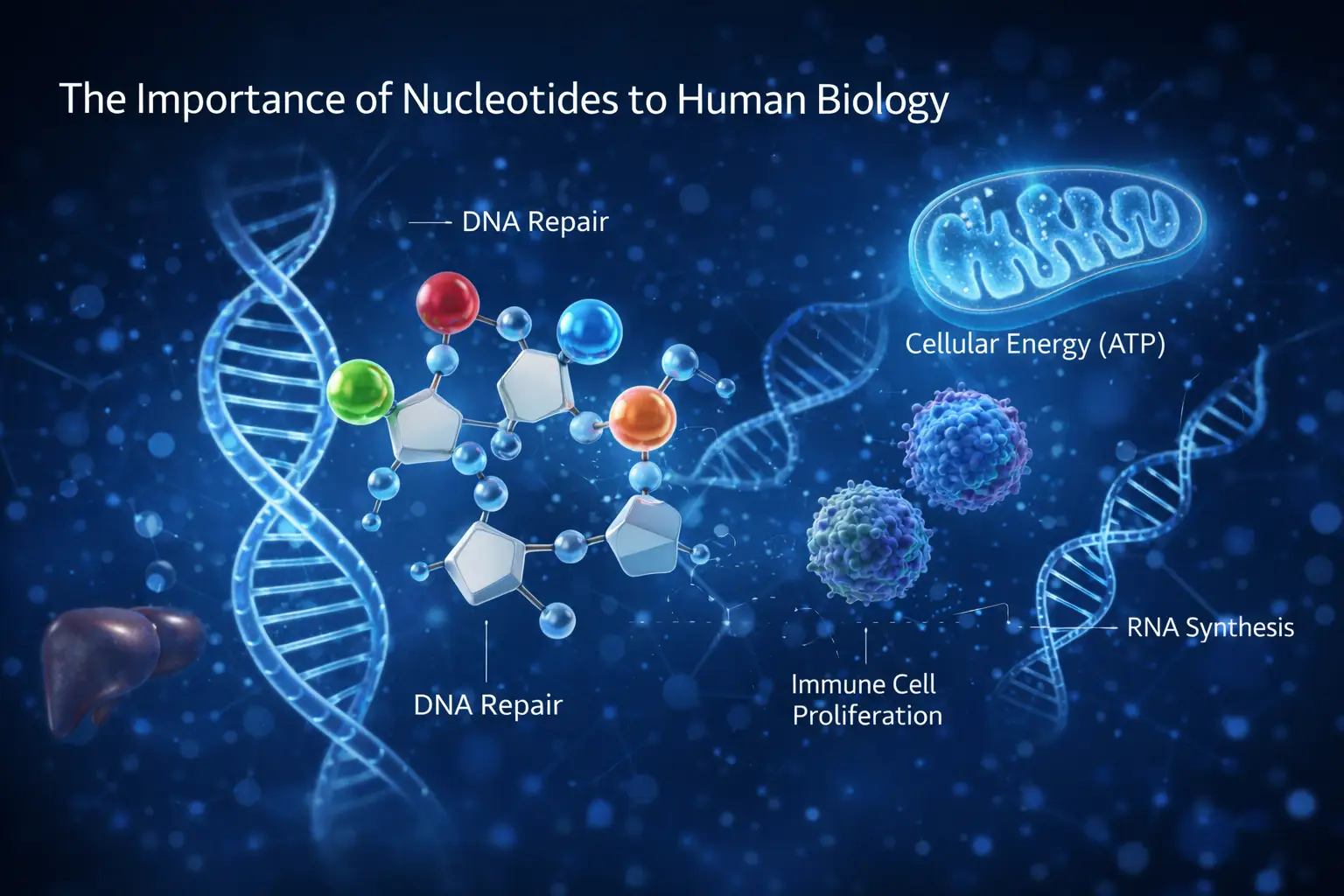
Nucleotides are fundamental molecules that support core biological functions in every living cell. Although they are commonly recognized as the building blocks of DNA and RNA, their physiological role extends far beyond genetic structure.
In human biology, these molecules participate in multiple essential processes that help sustain cellular integrity and systemic function.
1. Cellular Energy Metabolism
Adenosine triphosphate (ATP), a nucleotide-derived molecule, serves as the primary energy currency of the cell. For example, ATP enables:
- Muscle contraction
- Biosynthetic reactions
- Membrane transport
- Signal transmission
Therefore, without adequate nucleotide availability, efficient energy transfer cannot be maintained.
2. DNA Repair and Genomic Stability
Cells are continuously exposed to oxidative stress, environmental factors, and replication errors. As a result, nucleotides are indispensable for:
- DNA repair pathways
- Replication fidelity
- Maintenance of chromosomal integrity
In this context, genomic stability is a cornerstone of long-term cellular health.
3. RNA Synthesis and Protein Translation
RNA synthesis depends directly on nucleotide availability. These RNA molecules guide protein production, which regulates:
- Enzyme activity
- Structural protein formation
- Cellular signaling pathways
In addition, efficient nucleotide metabolism supports accurate gene expression and cellular adaptation.
4. Immune Cell Proliferation
Rapidly dividing immune cells require sufficient nucleotide pools to sustain replication and response. During physiological stress or immune activation, cellular demand may increase significantly.
Endogenous Synthesis and Nutritional Considerations
The human body synthesizes nucleotides through de novo and salvage pathways. However, certain physiological states — including growth, recovery, metabolic stress, or aging — may alter nucleotide demand.
For this reason, understanding nucleotide metabolism provides insight into the intersection of molecular biology and nutrition science.
A Scientific Perspective
Nucleotides are not trend-driven compounds. Instead, they are intrinsic components of cellular life.
Continued research into nucleotide metabolism contributes to a deeper understanding of:
- Cellular resilience
- Energy homeostasis
- Biological maintenance mechanisms
Ultimately, advancing knowledge in this area requires scientific rigor, transparent methodology, and responsible interpretation.
Zhen-Ao Bio-Tech
Zhen-Ao Bio-Tech is committed to advancing research in yeast-derived bioactive compounds and molecular nutrition science.