From Infant Nutrition to Healthy Aging: Expanding the Role of Nucleotides
Introduction
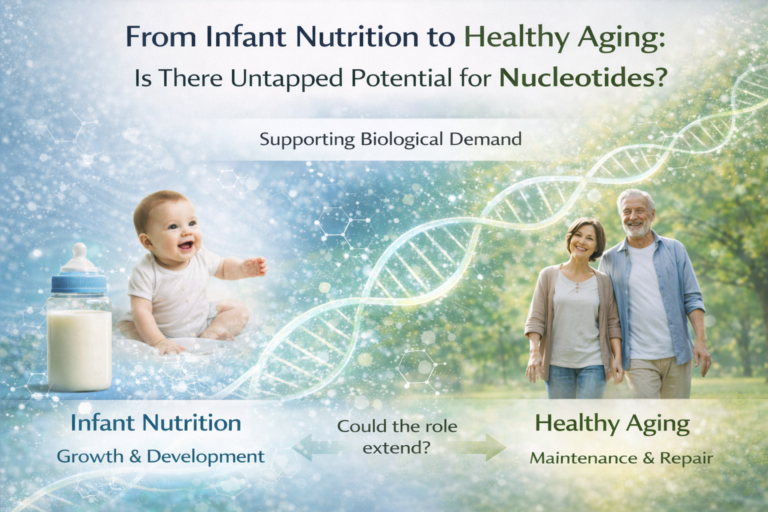
Nucleotides have long been recognized as essential components in early-life nutrition, particularly in infant formula, where their role in growth and development has been widely studied (Yu, 2002). Their role in supporting rapid growth, immune development, and intestinal maturation is well established and widely accepted across global regulatory frameworks.
However, an important scientific question is now emerging:
→Could the role of nucleotide nutrition extend beyond early development and into the domain of healthy aging?
From Growth to Maintenance:
A Shift in Biological Demand
Human biology is not static across the lifespan.
What changes is not the molecular foundation—but the nature of physiological demand.
→ Early life: rapid growth and cellular proliferation
→ Later life: maintenance, repair, and systemic resilience
This shift suggests that nutrients traditionally associated with development may also play a role in supporting biological function in later stages of life. Nucleotides, as fundamental building blocks of cellular processes, sit at the center of this discussion.
The Biological Role of Nucleotides
Nucleotides are involved in a wide range of physiological functions, including:
→ DNA and RNA synthesis
→ Cellular turnover and repair
→ Energy metabolism (e.g., ATP-related pathways) (Infant Formula Overview).
→ Signaling and regulatory processes
While endogenous synthesis can meet baseline needs, dietary nucleotides may become increasingly relevant under conditions of high demand, a concept often described as “conditional essentiality” (Singhal et al., 2010) —has been well explored in early-life nutrition and is now gaining attention in broader contexts.
Revisiting Nucleotide Nutrition Through the Lens of Aging
Aging is characterized by gradual changes in cellular function, including:
→ Reduced regenerative capacity
→ Accumulation of cellular damage
→ Alterations in metabolic and signaling pathways
Within this framework, nutritional strategies that support cellular renewal and systemic resilience are becoming a growing area of interest.
Emerging research in both human and animal models suggests that nucleotide metabolism may be relevant in:
→ Supporting tissue maintenance
→ Modulating biological aging-related markers
→ Maintaining overall physiological balance
While the field is still developing, the direction of inquiry is increasingly consistent across studies.
Zhen-Ao Bio-Tech: Four Decades of Nucleotide Science
At Zhen-Ao Bio-Tech, our work in yeast-derived RNA and nucleotide production spans over 40 years.
Our approach has always been grounded in a single principle:
supporting biological systems where demand is highest.
From early applications in nutrition to ongoing research in broader health contexts, this foundation continues to guide our scientific direction. Today, this perspective is being extended into new areas of exploration—including healthy aging.
Looking Ahead
The evolution of nutrition science is moving beyond isolated life stages toward a more integrated, lifespan-based perspective.
In this context, nucleotides represent a compelling area of study—not as a new molecule, but as a reconsidered one.
While further research is essential, current evidence suggests that the role of nucleotide nutrition may be broader than previously understood.
The question is no longer whether nucleotides matter—
but where else they may matter.
Explore More
To learn more about our work in nucleotide science and fermentation-based innovation:
Visit: www.zabiotech.com
Or contact us for scientific collaboration and partnership opportunities
Further Reading Nucleotide supplementation in infant nutrition
https://pubmed.ncbi.nlm.nih.gov/12410863/ Conditional essentiality and infant growth
https://pubmed.ncbi.nlm.nih.gov/20837597/ Immune function and dietary nucleotides
https://pubmed.ncbi.nlm.nih.gov/11755037/