A Scientific Perspective on Precision Nutrition in Healthy Aging
As longevity science advances, aging is increasingly understood not as a single disease, but as a progressive decline in the body’s ability to maintain cellular function, repair damage, and preserve metabolic resilience over time.
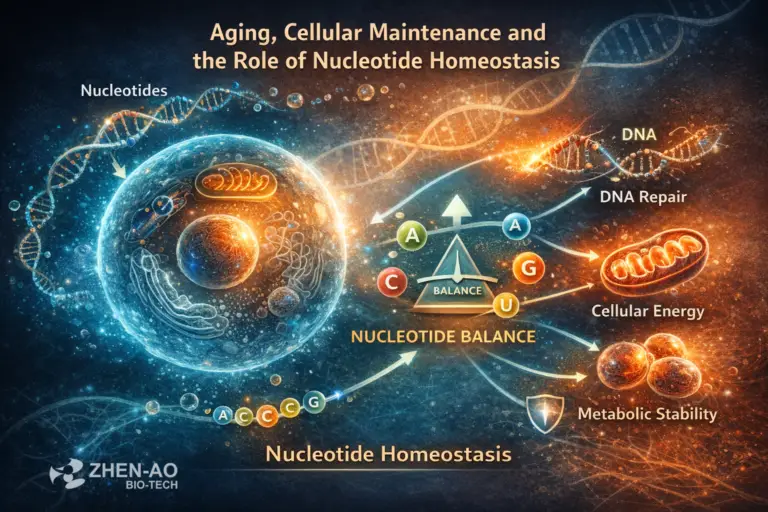
Recent research in aging biology has highlighted an important but often overlooked dimension of this process: age-related changes in nucleotide homeostasis. Rather than focusing solely on accumulated molecular damage, emerging evidence suggests that aging cells may struggle to sustain the nucleotide supply and regulatory balance required for ongoing maintenance and repair.
Aging Beyond Damage Accumulation
Traditional views of aging often emphasize the gradual buildup of DNA damage, oxidative stress, and protein misfolding. While these factors are undeniably important, they represent only part of the picture.
Equally critical is the declining capacity of cells to respond to damage once it occurs. DNA repair, mitochondrial maintenance, and controlled protein turnover all depend on tightly regulated nucleotide metabolism. When this regulatory capacity weakens, even modest stressors can have disproportionate functional consequences.
This shift—from damage accumulation to diminished maintenance capacity—has become a central theme in modern aging research.
Nucleotide Homeostasis as a Cellular Bottleneck
Nucleotides serve as fundamental building blocks for DNA and RNA, but their biological role extends far beyond genetic replication. In normal, non-proliferative cells, nucleotides are continuously required to support:
- — DNA repair and genomic stability
- — Mitochondrial DNA maintenance
- — Cellular stress responses
- — Basal metabolic regulation
Recent aging-focused studies indicate that both de novo nucleotide synthesis and salvage pathways may become less efficient with age. This does not immediately result in catastrophic failure, but rather in a gradual loss of functional reserve. Cells remain viable, yet increasingly constrained in their ability to maintain homeostasis under stress.
Importantly, this phenomenon is distinct from cancer biology, where nucleotide metabolism is often intentionally disrupted as a therapeutic strategy. In the context of healthy aging, the challenge is not to suppress nucleotide availability, but to understand how age-related regulatory shifts alter cellular demand and utilization.
Precision Matters: Context Over Generalization
One of the most significant insights from contemporary aging research is that nutritional biology is highly context-dependent.
Age-related changes in nucleotide metabolism do not imply that indiscriminate supplementation is beneficial. On the contrary, aging cells appear to respond sensitively to timing, dosage, and metabolic context. Interventions that are misaligned with physiological state may be ineffective—or even counterproductive.
This reinforces a broader principle in longevity science:
supporting healthy aging requires precision, not generalization.
Understanding when, how, and for whom nutritional strategies may support cellular maintenance is far more important than the quantity of any single nutrient.
Implications for Healthy Aging Research
The growing body of evidence linking aging to declines in cellular maintenance capacity has important implications for future research directions:
- — Aging interventions should prioritize functional resilience rather than cosmetic biomarkers.
- — Long-term, low-intensity strategies may be more biologically appropriate than short-term, high-intensity approaches.
- — Mechanism-driven research is essential to distinguish supportive interventions from contextually inappropriate ones.
These insights are shaping a new generation of aging research—one that emphasizes biological nuance, systems thinking, and translational discipline.
Zhen-Ao Bio-Tech’s Perspective
At Dalian Zhen-Ao Bio-Tech, we view aging biology through the lens of cellular function and metabolic balance. Our long-standing work in yeast biotechnology, nucleotides, and precision fermentation has reinforced the importance of understanding biological context before pursuing application.
Rather than treating aging as a condition to be “reversed,” we believe the future of healthy aging lies in supporting the body’s intrinsic capacity for maintenance and repair, guided by rigorous science and responsible translation.
As aging research continues to evolve, Zhen-Ao Bio-Tech remains committed to advancing evidence-based, mechanism-informed approaches that respect the complexity of human biology and the principles of long-term health.
References
Selected insights informed by recent peer-reviewed research in aging biology and nucleotide metabolism (PMID: 40362739).